

Toll Free:
1-877-270-9985, Phone:
519-653-1301, Fax:
519-653-2253
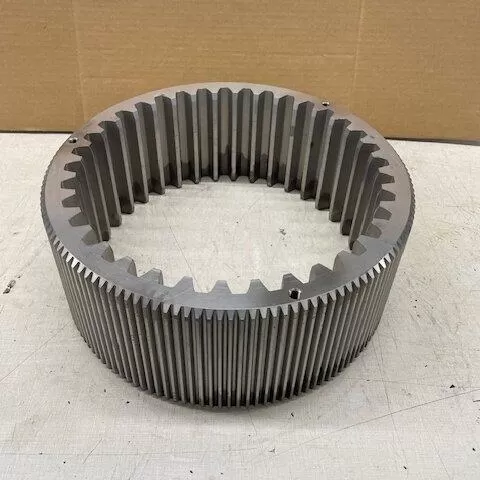
A gear coupling is a mechanical device that connects two rotating shafts, either on the same line or is slightly misaligned, to smoothly transmit power and torque. It mainly comprises two hubs, one with internal and the other with external teeth, complemented by one or multiple sleeves. The primary application of gear couplings lies in operating any equipment that has a drivetrain, such as pumps, compressors, blowers, mixers, and more.
up to 60" diameter
Gear couplings are used in numerous industries, ranging from drivetrains, pumps. Blowers, mixers, and more. Apart from utilizing couplings for gear pumps, here are some general applications of these devices:
- Agricultural Equipment: Crown gears are highly effective for power transmission in the agricultural sector, especially in rotary tillers and other types of heavy-duty equipment
- Hand Tools: A variety of hand tools, such as power drills, often employ crown gears
- Mechanical Clocks: Crown gears are often used in mechanical clocks in the winding and time-setting mechanism
- Printing: Printing, including 3D printing, utilizes crown gears in its machinery
- Textile Machinery: Crown gears are used in textile machinery due to their ability to transfer motion between two shafts at a 90-degree angle
- The biggest feature of crown gears is their ability to transmit power at a 90-degree angle
- This feature allows them to be used in many applications with spatial constraints
- Although they don’t have very high load-bearing capacity, crown gears are still a cost-effective choice in most applications
As one of the leading gear couplings manufacturers in the country, we pride ourselves on using only quality steel to produce effective gear couplings suitable for all manners of drive trains.
The major advantage of gear coupling lies in the effective transmission of high torque, which adjusts any form of angular or parallel misalignment that may occur with prolonged usage.
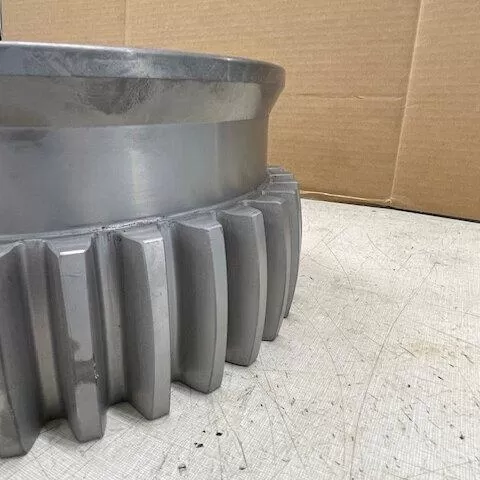
True Gear & Spline Ltd. manufactures a wide range of gear couplings of varying diameters up to 60'', and to ensure the best quality, we only use steel for all our products. We also specialize in manufacturing customized gear couplings and related equipment based on the drawings and specifications provided by the client.
Gear coupling is a critical component in conveyor systems, especially in a drive roller. The main aim here is to dampen the vibrations caused by the system and to accommodate any misalignment that might occur. In this case, a gear coupling, such as a jaw coupling can be used to connect the motor and drive roller via a shaft. Thus, a gear coupling here can minimize vibrations, maximize torque, and adjust for any possible misalignment during operation.
At the most basic level, gear couplings comprise a hub and two shafts, which are connected to two identical external gears on each shaft. Each external gear is separated from the internal gears using bolts and O-rings. The internal gears of the two shafts meant to be coupled are placed within a sleeve. The teeth of the internal gears mesh together to transmit power and torque. The teeth set within the sleeve are typically crowned, that is, their thickness is increased or decreased along the tooth's axis to counter angular misalignment. For smooth operation, lubrication is a key catalyst in the coupling, which is kept in place using the O-rings mentioned above.
Gear couplings can be broadly sub-classified into the following categories:
Full Gear Couplings: Used in a vast majority of industrial applications, this gear coupling allows for both offset shaft misalignment as well as angular misalignment
Half Gear Half Rigid Couplings: One end is rigid, and the other is open. The rigid end features a flanged hub.
Rigid Couplings: Gear coupling where both connecting shafts are completely aligned. Only suitable for applications where exact alignment is guaranteed.
Slide Couplings: Critical to facilitate axial movement and to accommodate thermal expansion of the shaft.
Shear Pin Couplings: This type of gear coupling acts as an emergency switch. When the load is too high, the pin breaks and the coupling stops working. This is done to prevent widespread damage to the machine. This is a useful coupling for gear pumps that can face clogging.
Require couplings for gear pumps or any other specific application? Contact us today at True Gear & Spline Ltd. at 519-653-1301. As a leading name among gear couplings manufacturers in the country, our state-of-the-art facility is equipped to handle a wide variety of gear manufacturing, gear coupling, and CNC machining operations. Get in touch with us today to manufacture the ideal gear coupling for your specific application.
The main purpose of gear coupling is to transmit power and torque between two rotating shafts. The gear coupling may or may not account for misalignment between the two shafts.
To accurately identify the right coupling size, please consider the following parameters: bore size or diameter, torque rating and dimensions. Of course, the list is not exhaustive by any means, but these 3 are the most fundamental criteria.
Most gear coupling manufacturers opt for carbon steel for the hub and outer gears. The steel may or may not be hardened further depending on the application. True Gear & Spline Ltd. also uses steel for all its gear couplings.

Request a quote today and discover why industries across North America trust us for their gear manufacturing needs.