

Toll Free:
1-877-270-9985, Phone:
519-653-1301, Fax:
519-653-2253
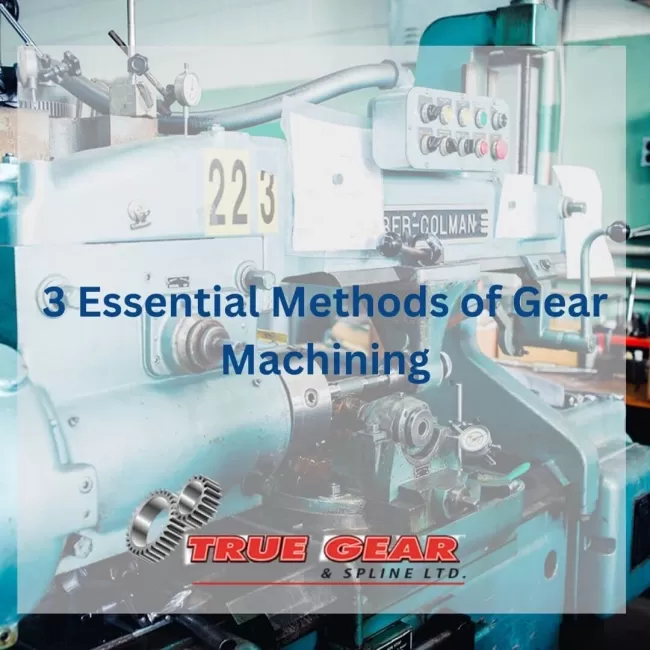
Gears are crucial for the functioning of mechanical systems across industrial setups. Imagine a world without gears. All the manufacturing and industrial units would come to a halt and the losses would be unfathomable. Simple in design yet highly effective in transferring torques, there is no replacement for gears. It can be argued that the simple yet effective design is what makes gears irreplaceable. However, the design of gears tricks you into believing that gear manufacturing is a fairly simple process. This cannot be farther from the truth. Gear manufacturing is an intricate process that involves state-of-the-art tools and machinery. Machining is an inextricable part of gear manufacturing. While there are various methods of gear machining, we focus mainly on three — Gear generation, gear shaping, and gear hobbling.
Gear generation involves the use of sophisticated cutting tools like rack cutters. This is often the first step in manufacturing machined gears. There are different methods of producing machined gears. We list below some of the most common ones:
Gear form cutting is one of the essential methods in gear machining. It involves shaping gears by removing excess material from a blank piece using various machines.
Milling is one of the most common types of gear form cutting. In gear milling, a sophisticated machine removes material by rotating at high speeds while making contact with the gear. CNC machines are preferred by gear manufacturers for milling owing to their high efficiency and ease of operation.
Another method of gear cutting that's often used is electrical discharge machining (EDM). The process uses an electrode to remove material from a conductive surface that's placed in close proximity to it. This results in incredibly accurate cuts, making EDM perfect for producing intricate gears.
Planing and slotting are also popular forms of gear cutting. Planing machines use a linear reciprocating motion to move their tools across the workpiece, creating flat surfaces or grooves on them as needed. Slotting machines, on the other hand, create slots by removing material along specific lines. The combination of planing and slotting results in industrial-grade gears.
When it comes to gear forming, there are three essential methods that manufacturers can use: rolling, casting and powder metallurgy. Each method has its own unique advantages and disadvantages depending on the specific requirements of the project.
When it comes to gear machining, finding a reliable and experienced company is essential. True Gear & Spline Ltd. has been providing top-quality gear manufacturing services for almost five decades.
Our team of experts specializes in all types of gear machining, including gear shaping, hobbing, milling and more. Our quality check is on-point and stringent, ensuring that all the gears and splines we manufacture meet the highest standards. The combined experience of our staff is what makes us stand out from the rest of our competitors. Through our decades of experience in manufacturing gears, we have handled projects of all types.
Our continued success is a reflection of our commitment to customer satisfaction and excellence. Our extensive 22,000-square-foot facility in Cambridge, ON is equipped with state-of-the-art equipment and CNC machines. Whether you need custom gears or a high-volume production run, True Gear & Spline Ltd. has the capabilities to meet your needs on time and within budget. Contact us to discuss your gear manufacturing needs today.
Request a quote today and discover why industries across North America trust us for their gear manufacturing needs.