

Toll Free:
1-877-270-9985, Phone:
519-653-1301, Fax:
519-653-2253
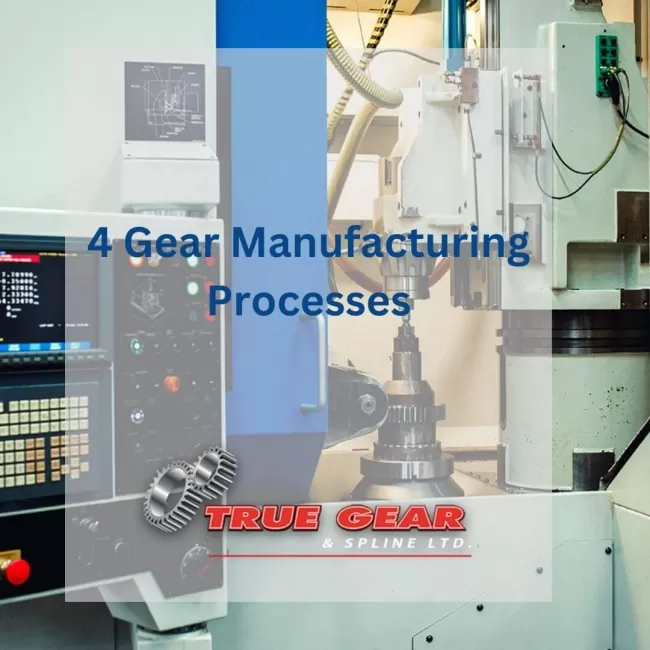
Gear manufacturing is an art that can be mastered only by truly dedicated professionals. It takes years of practice and a plethora of modern machinery for an average gear manufacturer to produce flawless results. This is why businesses choose to work only with professional gear manufacturers with a proven track record. Gears are indeed the unsung heroes of countless industries, quietly working behind the scenes to keep the machinery running smoothly. Whether for transmitting power or controlling motion, machinery cannot do without strong and sturdy gears. But have you ever wondered how these mechanical marvels are made? Read this blog until the end if you are interested in understanding the methods of gear manufacturing. In this blog, we briefly discuss the four most important gear-making processes.
The gear-making process is complex, to say the least. A wide range of gear manufacturing methods are used to convert metal discs or blanks into intricate gear with perfect teeth. Any deviation in the process can lead to disastrous effects. Gear cutting is a fundamental process in gear manufacturing, playing a crucial role in producing high-quality gear. Several methods are used for gear cutting, each with its benefits.
One common method is gear hobbing. In this method, a specialized tool called a hob is used to cut teeth into the gear blanks with extreme precision. This method allows for fast and efficient production of gears with excellent accuracy. One of the biggest advantages of hobbing is that it is fast as well as efficient. The diversity of hobbing enables gear manufacturers to manufacture straight and worm gears.
Milling is another popular method, where rotating cutters remove material from the workpiece to create the desired tooth profile. It offers versatility and can be used for both small and large-scale productions. Broaching, on the other hand, uses a broach tool to cut teeth into the workpiece's surface progressively.
Conclusion
The four key gear manufacturing processes - cutting, forming, grinding, and heat treatment - each contribute to the creation of gears that meet these standards. Gear cutting allows for precise shaping of the teeth on gears using methods like hobbing, shaping, milling, and broaching. Gear forming involves forging or casting metal to create gears with desired properties. Gear grinding ensures precision by removing imperfections left by other processes. And finally, heat treatment enhances the durability and toughness of gears through techniques like carburizing and quenching. True Gear & Spline Ltd. is a leading gear manufacturer that employs the best technique for manufacturing all types of gear. Our extensive facility in Cambridge, ON is equipped with all the latest CNC machinery. The combination of the latest equipment and experienced employees makes it possible for us to deliver custom gear with precise tolerances. Look no further than True Gear & Spline Ltd. for all your gear manufacturing needs.
Request a quote today and discover why industries across North America trust us for their gear manufacturing needs.